Warhounds Destructible Cover, Flanking, and Elevation Guide
Use destructible cover, flank angles, high ground, and safe fallback positions without relying on unverified defense values or map scripts.
Quick Answer
Destructible cover and destructible environments are confirmed retail features: both the current Steam store page and the official Warhounds website advertise them, alongside flank angles, lines of fire, and high ground. Exact cover defense values, destruction thresholds, and elevation bonuses are not yet verified in the current retail build, so this guide works from geometry principles rather than unpublished numbers.
Cover in Warhounds is a changing part of the battlefield. Official material highlights destructible protection, flank angles, and high ground, so a safe tile at the start of a turn may become a dangerous lane after terrain damage or enemy movement.
Verification boundary
- Released 1.0: Destructible cover, flanking, lines of fire, and elevation are advertised retail mechanics.
- Demo-era: Exact defense bonuses, cover categories, destruction thresholds, and movement costs from pre-release footage require 1.0 confirmation.
- Roadmap: No future terrain system is assumed.
- Community observation: Advice such as “always take high ground” ignores sight lines, access routes, and objective timing.
Judge cover by what it blocks
A cover icon is only the beginning of the decision. Ask which enemies can see the tile, which angles bypass it, and what happens if the object is destroyed.
Good cover should support a specific plan:
- protect against the most dangerous visible lane;
- let the operative contribute to the objective;
- avoid exposing the squad to an easy side angle;
- leave another reachable position if the object breaks.
Cover that blocks your own line of fire may be useful for survival but poor for pressure. Compare both sides of the geometry, then use the ballistics and line-of-sight guide to judge the resulting attack rather than assuming a clear lane guarantees a hit.
Create a flank without creating a casualty
Flanking can improve a shot by changing the angle around protection. The risk is that the flanker may leave mutual support or reveal a new line from unseen enemies.
Use a controlled sequence:
- Gather information with available vision, scanners, or drones.
- Identify the exact cover edge you need to bypass.
- Check the route and final tile, not only the firing tile.
- Keep a second operative or utility option ready if the target survives.
- Reassess after terrain is destroyed or another enemy appears.
The best flank is one the campaign can afford, not simply the farthest movement.
Use elevation for lanes, not status
High ground matters when it creates a clearer or safer line. It can also make an operative isolated, visible, or slow to reach the objective. Before climbing, check:
- which lanes become available;
- which enemies gain a lane back;
- whether the position has durable cover;
- how long it takes to leave;
- whether the mission timer or escort route makes the detour worthwhile.
No universal accuracy bonus is published here because exact retail values need direct in-game verification.
Expect the map to change
When cover can be destroyed, position the squad so one explosion or burst does not expose everyone along the same line. Spread enough to create alternatives without separating operatives beyond support range.
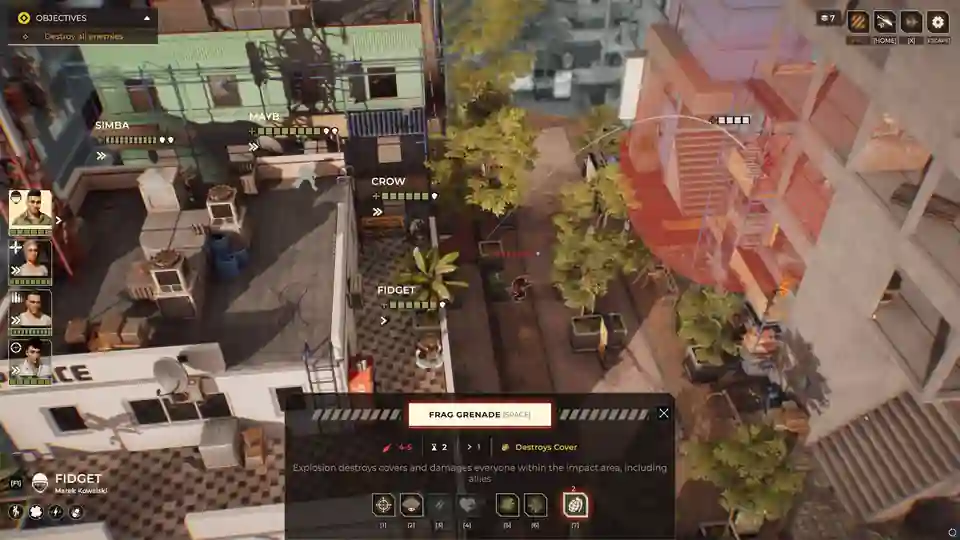
The Frag Grenade targeting preview explicitly labels the action “Destroys Cover” and shows its impact area across the battlefield environment. Official press-kit screenshot, version 1.0.0 (2997); this is a pre-attack preview, not the post-destruction result, and it does not establish current cover HP, defense bonuses, destruction thresholds, or current-patch numeric rules. View full-size image. Image: Everplay DMCC / Brightika, Inc., via the official press kit.
Terrain destruction can also be proactive. Removing a target’s protection may create a better attack for a later operative, but it is only valuable if the squad still has actions and a safe follow-up. Damage to the object is not the objective by itself.
If the new lane crosses a likely enemy route, the cone Overwatch guide covers how to hold it without inventing unverified trigger or accuracy rules. For smoke, scanners, and other ways to handle poor geometry, see the weapons and equipment guide.
Frequently asked questions
Does cover guarantee a miss?
No. Cover changes the tactical situation; attacks still use probability. The live preview is more useful than assuming immunity.
Is high ground always better?
No. It is better when it improves useful lines without making the operative isolated or late to the objective.
Should I destroy every enemy cover object?
No. Spend effort on terrain only when the opened lane helps complete the mission or removes a major threat.
Sources
Sources & Verification
- Official — currentWarhounds on SteamSteam / Warhounds · Checked September 28, 2026
- Official — currentWarhounds Official WebsiteWarhounds · Checked August 18, 2026
- Official — historicalWarhounds official press kit and downloadable media assetsgame.press / Brightika, Inc. / Everplay DMCC · Checked September 15, 2026