Warhounds Combat Guide
Learn how hit chance, line of sight, true ballistics, cover, flanking, elevation, overwatch, RNG, and damage rolls work in Warhounds.
Warhounds combat is built around information, positioning, and the consequences of committing an action. Official descriptions emphasize lines of fire, flanking, cover, elevation, destructible terrain, drones, scanners, smoke, optical camouflage, and cone overwatch. These systems make the visible battlefield state more useful, but they do not remove uncertainty from every shot or enemy response.
The combat hub separates confirmed features from details that still need controlled testing. It will not invent exact hit formulas, cover percentages, overwatch angles, action costs, or damage tables. Instead, it gives you a sequence for reading risk and links each uncertain rule to the evidence needed before the claim can become a reference.
Read the Shot Before You Spend the Action
Begin with line of fire: identify the intended target, any intervening geometry, the attacker’s exposure, and the positions that could answer the shot. Then compare the current attack with a move that improves the angle or removes cover. Elevation and flanking may create a better opportunity, but the gain only matters if the operative can survive the new position and the squad can respond to a miss.
Warhounds uses probabilistic outcomes. The store’s phrase “less fake RNG” should be read alongside the developer’s shooting explainer, which documents hit and damage randomness while arguing for clearer feedback. A sound plan therefore has a failure branch: preserved actions, overlapping fire, smoke, concealment, or a route out of exposure.
Control Movement With Tools and Threats
Cone overwatch is confirmed in current Steam copy, but the exact cone width, range, triggering conditions, accuracy treatment, interruption behavior, and action cost remain verification targets. Use the guide to understand the tactical purpose of reaction fire without assuming undocumented values. Position it where an enemy must choose between delay, exposure, or entering a threatened route.
Detection and concealment tools broaden that control. Drones and scanners can reduce information risk; smoke and optical camouflage can change movement options. Their precise values still belong to the released game, so evaluate them by the objective they support: revealing a route, screening a crossing, protecting recovery, or creating a safer attack.
See Warhounds Combat in Motion
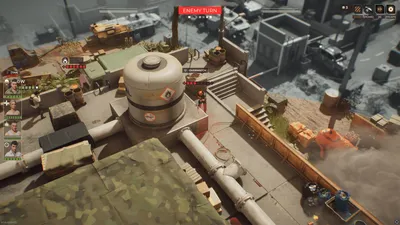
This publisher-listed near-launch trailer shows Warhounds tactical combat in motion. Use it to connect movement, positioning, cover-heavy terrain, vertical spaces, environmental destruction, and attack flow to the concepts above—not as evidence for current damage, accuracy, action costs, overwatch geometry, or other patch-sensitive values.

Publisher-listed IGN Release Date Trailer · July 14, 2026 · Pre-release footage
Warhounds Destructible Cover, Flanking, and Elevation Guide
Use destructible cover, flank angles, high ground, and safe fallback positions without relying on unverified defense values or map scripts.
Last updated: 9/28/2026
Warhounds Overwatch and Reaction Fire: Verification-First Guide
Use safe reaction-fire principles while distinguishing released Warhounds facts from demo-era Overwatch rules that still need retail verification.
Last updated: 9/6/2026
Warhounds Ballistics, RNG, and Line-of-Sight Guide
Understand independent bullet hit chances, random damage, critical hits, grazes, lines of fire, and safer probability management in Warhounds.
Last updated: 9/28/2026